
09 July 2026 – As part of the ICPerMed Strategic Working Group on Internationalisation, a webinar titled ‘Genomics Infrastructures and AI-Enabled Omics’ was organised for 30 July 2026, running from 15:00 to 16:30 CEST. The webinar comprised two parts: First, Graziano Pesole provided an overview of the European 1+ Million Genomes (1+MG) Initiative and Genomic Data Infrastructure (GDI). In the second part, Bruno Fosso explored AI-driven multi-omics for microbiome investigation.
Recording
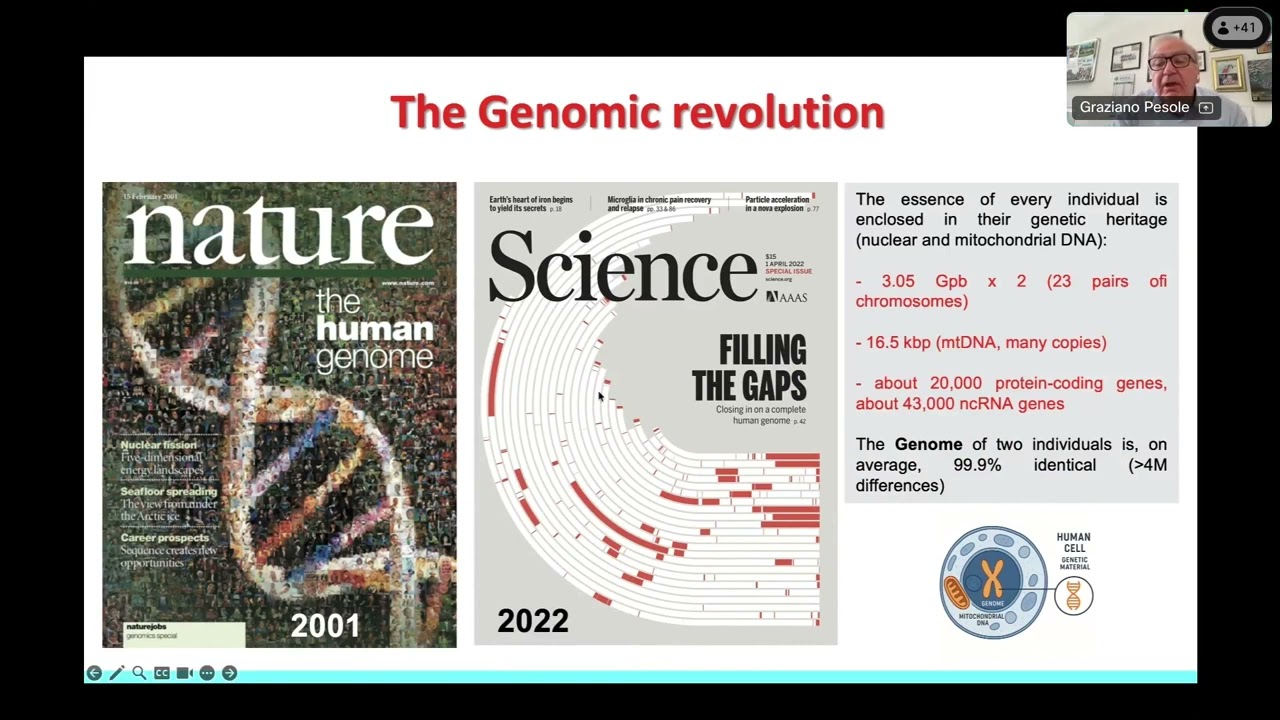
Part 1: The European 1+ Million Genomes Initiative and the Genomic Data Infrastructure (GDI): Opportunities and Challenges for Italy
This webinar will provide an overview of the European 1+ Million Genomes (1+MG) Initiative, one of the most ambitious health data initiatives ever launched in Europe. Established in 2018 and currently supported by more than twenty European countries, the initiative aims to enable secure and federated access to genomic and associated clinical data across Europe, fostering advances in biomedical research, precision medicine, and public health. The implementation of the initiative is based on the development of common legal, ethical, technical, and interoperability frameworks to ensure that genomic data can be shared and analysed across national borders while fully respecting citizens’ privacy and data protection regulations.
Particular attention will be devoted to the Genomic Data Infrastructure (GDI) project, the main operational vehicle for implementing the 1+MG vision. GDI is establishing a federated European infrastructure that will enable secure access to genomic, phenotypic, and clinical data through interoperable national nodes, creating the foundations for large-scale genomic medicine and research across Europe. The project aligns with other major European efforts, including the European Health Data Space (EHDS) and the Genome of Europe project.
The webinar will also highlight the Italian contribution to these initiatives. Italy was among the early signatories of the 1+MG Declaration and is actively participating in GDI with the support of the Ministries of Health and University and Research. Through the coordination of the Italian ELIXIR Node and major investments such as ELIXIRxNextGenIT and other PNRR-funded projects, Italy is developing a national federated infrastructure for human omics data that will contribute to the European genomic ecosystem and support the integration of genomic information into the healthcare system.
The webinar will discuss the scientific, technological, and societal impact of these initiatives and their potential to accelerate precision medicine, improve healthcare outcomes, and strengthen Europe’s leadership in genomic research and innovation.
Graziano Pesole, PhD

Graziano Pesole is Full Professor of Molecular Biology at the University of Bari Aldo Moro, Associate Research Director at CNR-IBIOM, and Head of the Italian Node of ELIXIR, the European Research Infrastructure for Life Sciences.
He is widely recognized as one of the pioneers of Bioinformatics in Italy, having contributed since the early stages of the field to the development of computational approaches for genomics, molecular evolution, and large-scale biological data analysis. His research spans bioinformatics, comparative genomics, transcriptomics, and RNA biology, with a particular focus on next-generation sequencing technologies, single-cell and spatial omics, and the characterization of transcript structure and RNA modifications.
Over the years, he has developed several widely used bioinformatics databases, software tools, and analytical methods, and has led numerous national and international research projects funded by agencies including the European Union, NIH, CNR, Telethon, AIRC, and the Italian Ministry of University and Research. He currently coordinates major initiatives funded through the Italian National Recovery and Resilience Plan (PNRR), including the Biocomputing Spoke of the National Center for the Development of Gene Therapy and RNA-Based Drugs.
He has authored more than 400 peer-reviewed publications, holds several international patents, and has received over 30,000 citations excluding self-citations (h-index: 90 Google Scholar; 73 Scopus).
Part 2: AI-Driven Multi-Omics for Microbiome investigation
The advent of High Throughput OMICS platforms, such Next Generation Sequencing (NGS) ones, have completely revolutionised how scientists investigate genomes, metabolomes or proteome. Furthermore, it allowed us to also unveil the complexity of microbial communities colonising every biological niche, such the human body. The steadily increasing amount of data deposited in publicly accessible databases laid the basis to investigate biological data through Machine Learning (ML) and Artificial Intelligence (AI) applications to extract complex patterns from large-scale datasets.
In genomics and transcriptomics, ML models help identify biomarkers, gene expression signatures, and disease-associated variants. In this context, applying multi-omics approaches allows one to snapshot the same phenomena from different points of view and find associations among biological entities (e.g. genes, transcripts, proteins, etc.) driving specific effects. ML/AI applications well cope with multi-omics application by facilitating both features selection and data-integration its-self. Finally, despite the fact that the ML/AI model can be perceived as black box, Explainable AI (XAI) methods provide insights into model decisions and feature importance.
Bruno Fosso, PhD

Bruno Fosso is Associate Professor in Molecular Biology at the University of Bari Aldo Moro and co-lead of the ELIXIR-IT Tools platform. He obtained his Ph.D. in Bioinformatics in 2014 at the University of Bari.
Since 2014, initially as post-doc researcher and from 2019 as permanent researcher, he worked at the Institute of Biomembranes, Bioenergetics, and Molecular Biotechnologies – IBIOM (CNR). In 2022, he started a Tenure Track position (RTDb) at the University of Bari “Aldo Moro”. The metagenomic investigation of host-associated microbiomes and environmental prokaryotic communities is the main topic of his research activity. During the last 10 years, he has developed tools and databases for both metabarcoding-based and shotgun metagenomics-based investigations of microbial communities. He participated in several Italian (MICROMAP, OMICS4FOOD) and European projects (BIOVEL, EMBRIC, LIFEWATCH, EXCELERATE, ELIXIR, BGE) and he currently is an active member of the BITS (Bioinformatic Italian Society), SIBBM (Italian Society of Biophysics and Molecular Biology) and ISCB (International Society of Computational Biology). He is the author of about 60 papers in international journals (H-index 26, Citation ≥ 2,300).
This is the seventh event of a series of webinars with the aim to overall increase the awareness about Personalised Medicine and to share information about activities and successes in the field.